I find that Augustus was a better Roman leader as he started an era of peace in Rome. The Pax Romana, or Roman Peace. He Built a permanent, professional army of 150,000 men and he founded a special unit called the Praetorian Guard. This consisted of 9,000 men who were in charge of guarding the emperor. Later, this became very important in politics. Augustus also conquered new territories, rebuilt Rome, he imported grain from Africa for the poor because he knew that they would cause less trouble if they were well-fed. He appointed a consul or governor to each of Rome's provinces, he reformed laws to make them easier to understand and apply and he reformed the Roman tax system.
Sunday, November 27, 2011
Tuesday, November 22, 2011
Julius Caesar
From my point of view, Julius Caesar was a Reformer. Even though he was believed to be too ambitious and did things that may make him seem like a dictator, Caesar did many memorable things for many people. Caesar had a very good military strategy and won the support of his soldier. He strengthened and expanded Rome and started jobs so that the poor could become wealthier. Caesar also treated his defeated enemies fairly and generously. To some, he even gave government positions and to others that came from a foreign state, granted citizenship. By doing this, he ended the rule of corrupt Roman nobles.
In conclusion, he was admired greatly by the people and brought order and peace to Rome.
Wednesday, November 16, 2011
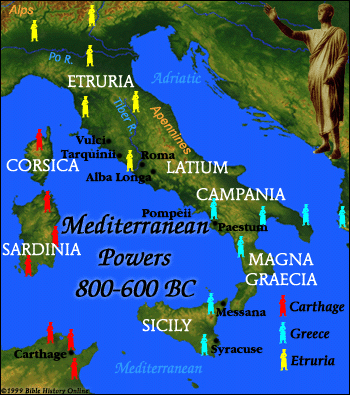
The Italian peninsula
Explain in detail how the geography and the climate of the Italian peninsula affected the development of ancient Rome.
Italy is located in the Mediterranean region. The Mediterranean sea was a good way to get to the rest of the Mediterranean world. But Italy was far enough to escape sea raids by pirates.
Italy had much better farmland than Greece. Thus, there was a large capacity to produce food. By producing more food, Italy could supply much more people. Unlike Greece, Italy was unified and was not divided into many city-states.
When Rome was built, the site chosen was about 15 miles, or 24 km, up the Tiber river from the Mediterranean sea. The Tiber wasa great source of water and an easy access to the Mediterranean sea.
Rome was built on seven hills. The hills were steep. This made it more difficult for the enemies to attack and easier for Romans to defend themselves. There is evidence that northern people slipped through Italy's mountains around 1500 B.C. or 1000 B.C. Most of the newcomers were Latins. Rome became a stopping place for travelers and ships from the Mediterranean sea.
Italy is located in the Mediterranean region. The Mediterranean sea was a good way to get to the rest of the Mediterranean world. But Italy was far enough to escape sea raids by pirates.
Italy had much better farmland than Greece. Thus, there was a large capacity to produce food. By producing more food, Italy could supply much more people. Unlike Greece, Italy was unified and was not divided into many city-states.
When Rome was built, the site chosen was about 15 miles, or 24 km, up the Tiber river from the Mediterranean sea. The Tiber wasa great source of water and an easy access to the Mediterranean sea.
Rome was built on seven hills. The hills were steep. This made it more difficult for the enemies to attack and easier for Romans to defend themselves. There is evidence that northern people slipped through Italy's mountains around 1500 B.C. or 1000 B.C. Most of the newcomers were Latins. Rome became a stopping place for travelers and ships from the Mediterranean sea.
Tuesday, November 15, 2011
The Founding of Rome
Describe the two legends that tell of the founding of Rome. The describe how and when Rome was actually founded.
The first legend about the founding is about two twin brothers, Romulus and Remus. They would have been abandoned as babies near the Tiber river, rescued by a wolf and raised by a shepherd. The brothers decided to build a city in 753 B.C. The twins fought a lot with each other and one day, Remus made fun of the walls his brother had built and Romulus killed him. Romulus became the first king of Rome and named the city after himself.
The second legend can be found in the Roman poet Vigil's epic poem called The Aeneid. The Aeneid is the story of Aeneas and other Trojan followers. They sailed the Mediterranean after Troy had been destroyed. They landed at the mouth of the Tiber. Apparently, through warfare and marriage to the local king's daughter, Aeneas united the Trojans and the Latins (local people) and became the 'father' of the Romans.
Tuesday, October 25, 2011
Alexander The Great
Alexander III of Macedon, also known as Alexander the Great, was born in 356 B.C. and died in 323 B.C. He was known as 'Alexander The Great' because he conquered many city-states and invested into them. During his 13 years of ruling, he had created the largest empire in the western world.
His father, King Philip, was a military genius and had already won numerous wars, conquered many territories and established laws. When he passed away, his son, Alexander III of Macedon, took power.
Alexander The Great was a good leader because when he conquered a city-state, he did not ask the citizens to give up their religion, ways and traditions. Nonetheless, many people got used to being ruled by Alexander, or one of the generals he placed in every city-state he took over, and they adapted to the Greek traditions and started worshiping the Greek gods. Even today, some people in Central Asia are proud to say that the Greeks were their ancestors.
Alexander was tutored by Aristotle, one of Greece's greatest philosophers. Alexander would tell people that, " [...] from his father he had received life, but from Aristotle, he had learned how to lead a good life."
I like this quote and I find it explains that even though his father had given him territories and power, Aristotle was the one to really teach him what he needed to know and he thanks him for helping him become such a powerful leader.
Friday, October 21, 2011
A day in the life of...
Choose the life of a person who could have lived during the Golden Age in Athens.
Examples: wealthy merchant, seafarer trader, military, government, slave, metic, woman, child, etc.
Recount one day in that person's life using many details. You can include dialogue and other characters. It must be believable and realistic.
A DAY IN THE LIFE OF AN ATHENIAN CHILD
This morning, I got up, out of bed, got dressed, got ready and went downstairs to see what my mother and my sister prepared for breakfast. They always get up earlier and make sure that everything is ready to be served and eaten when my father and I come down for breakfast. While we eat our grapes, sip at out glass of water and nibble at our piece of bread, my father tellsus what he intends to do today.
'I will first go to the highest point of the Acropolis and go to the Parthenon to worship the goddess Athena's statue. Then I will go to the Agora and take part in discussions and socialize with other Greek men. I will go to the market to go buy what we need and later I will spend time in the gymnasium and go to the baths. If I have some time left, I might go see a play at the Theater of Dionysus. ' he explained.
But we already knew all of this because he would do it almost every day, sometimes in a different order.
'I will go to school, I will learn hoe to read, write and other useful things in life.' I said.
'I will be here,at home, weaving, cooking, washing and learning how to be a good wife and mother.' mumbled my older sister.
'And I am the one who will teach you all these skills.' announced my mother.
Now that we have finished eating, my father is leaving and going to the a Acropolis. I have to leave and go to school now, a new day starts.
Tuesday, October 11, 2011
'The Spartan Way' Article Summary
Article Summary
Sparta and Athens were the two most powerful city-states of Ancient Greece.
Athens was the birthplace of democracy, great artists and thinkers. But Sparta
was quite the opposite, it was an oligarchy and a city of order and discipline.
It dominated Ancient Greece from about 600 B.C. to 371 B.C. thus, it has an
unforgettable mark on History.
A Spartan soldier had to obey orders, ignore pain, fight to death, be strong and
be fearless about death.
The elders of the city would inspect newborn babies to see if they were strong
and healthy. If they were not, the baby would be left on a mountainside to die.
At the age of 7, the boys were taken from their families and they began
military training. The trainees were taught to obey and to endure pain, no sign
of suffering was expected and if they did, they would be whipped. The trainees
would only wear a cloak and were barefoot, even in winter.
Therefore, they were a fearsome army that terrorized Ancient Greece for more
than 200 years. Opposing armies would crumble at the very sight of the
Spartan soldiers.
The Spartan men's job was to be a soldier and he was not allowed to any
manual labor. Because of that, men had plenty of free time. They would take
part in choral dances, festivals, feasts, hunting expeditions, physical exercise,
and conversation.
Men were full citizens at the age of 30 and only after that were they able to
vote or hold a public office. They ate at the army mess halls, not with their
families. The Spartans 'looked down on any form of luxury, and their food was
deliberately bad tasting.'.
The women's job was to have children. The Spartan woman were as athletic as
men, they wrestled, threw javelins and exercised daily. They were not allowed
to wear jewelry, perfume or nice clothing. But they were allowed to own land,
run their own households, and do business.
According to Sean Price, "Such power was shocking to Greek men of other
city-states. One time, a visitor kidded a Spartan woman, saying, 'You Spartan
women are the only ones who can rule men.' She replied, 'This is because we
are the only ones who give birth to men.' "
I like this quote because it describes that the woman had some power in Sparta
the Ancient Greek times and that she was able to defend herself.
The Greek city states relied on slavery.
The Perioeci were Sparta's neighbors. They were free, but had no rights. They
lived in their own town and were usually treated well. Some of them became
rich craftsmen or traders.
The Helots were slaves owned by the Spartan government. No Greeks treated
their slaves more cruelly than the Spartans did. The citizens of Sparta were
outnumbered by the slaves, by nearly 10 slaves for 1 man.
The Helots that traveled at night, that seemed more intelligent or that looked
stronger than the others, was killed. The Helots revolted but they were out
down every time.
Sparta conquered Athens in the Peloponnesian war (from 431 B.C.to 404 B.C.).
In 371 B.C, the city-state of Thebes crushed Sparta'a army for good.
Romans took over Sparta in 146 B.C. and it was a tourist attraction to see
little boys that could be whipped without showing pain.
Price, Sean. "The Spartan Way." The Ancient World. 2010. Print.
Monday, October 10, 2011
'The Ancient Olympics' Article Sumary
Article Summary
We do not know exactly when the first Olympic Games were held but they were probably about three thousand years ago. The Olympic games were held to honor the Gods, especially Zeus, the king of all gods. They were held in a valley in Western Greece at a place called Olympia. The Olympics were so important that warfare ceased during the games. Apparently, the first person to win the Olympic games was Coroebus and he would have won the 180 meters footrace at the Olympic festival in 776 B.C. He was rewarded with a wreath of olive branches. It was the ultimate achievement to win the Olympics.
Only Greek male citizens could participate in the games; foreigners, slaves, and women were not allowed. Women could not even go watch the games or else, they would get killed. Over the years, this rule changed and now, woman can watch and also compete in the games. An Athlete competing in the Olympic games had to take the Olympic oath and swear that he had trained for ten months before the Games and that he had done nothing to offend the gods.
According to Theodore Knight, "The history of the Olympic Games parallels the history of Ancient Greece. Over the centuries, as Greece grew to be the most powerful nation in the civilized world, the Olympics grew also in size and importance.".
I think that this quote explains that the Olympics were considered a very important event in Greece and it still is but all over the world now. One evidence that the Games were extremely important was that all warfare ceased during the Games.
Knight, Theodore. "The Ancient Olympics." The Ancient World . Print. Only Greek male citizens could participate in the games; foreigners, slaves, and women were not allowed. Women could not even go watch the games or else, they would get killed. Over the years, this rule changed and now, woman can watch and also compete in the games. An Athlete competing in the Olympic games had to take the Olympic oath and swear that he had trained for ten months before the Games and that he had done nothing to offend the gods.
According to Theodore Knight, "The history of the Olympic Games parallels the history of Ancient Greece. Over the centuries, as Greece grew to be the most powerful nation in the civilized world, the Olympics grew also in size and importance.".
I think that this quote explains that the Olympics were considered a very important event in Greece and it still is but all over the world now. One evidence that the Games were extremely important was that all warfare ceased during the Games.
Sunday, October 9, 2011
Ancient Greek Values
1) What values were most important to early Greeks?
Based on the excerpts from the Odyssey that we listened to, I would say that the three most important values of Ancient Greece would be ingenuity, teamwork and justice.
We can see ingenuity in a lot of the excerpts of the Odyssey.
Penelope shows ingenuity when she tells the suitors that she will not get married until she finishes weaving a piece of cloth and she unravels all her work at night.
Odysseus also shows ingenuity when he tells the cyclops that his name is 'Nobody' so when the cyclops is in pain and screaming for help, he says that Nobody blind him and the other cyclops do not come to help.
Another excerpt where we see ingenuity is when Odysseus wants to hear the beautiful voice of the sirens, and thinks of a plan to do so without being in danger. He puts wax in the ears of his crew and he asks them to attach him to the mast of the ship.
The second value would probably be teamwork, the excerpts show us that Odysseus and his crew always work together and they are a team.
The crew shows teamwork when they blind the cyclops, when they do not remove the wax that Odysseus has put in their and when they kill all the suitors when Odysseus comes back to his house.
The third value is justice. We could say that justice is in every excerpt in a way but the ones where it is the most obvious is when Odysseus blinds the cyclops, when Odysseus promises to his friend Elpenor a proper burial. We also see justice when Odysseus beats the suitors at the archery contest and also when he kills them all with the help of his crew.
2)In what ways are early Greek values found in modern society?
At school, we are thought to be ingenious and to learn how to do things ourselves. We also see a lot of teamwork that teaches us how to work in groups and with different people. There is also justice because when somebody does something wrong, they are punished for it and if they do something really good, they are praised.
Thursday, September 29, 2011
The Minoan and Mycenaean Civilizations
Minoans:
The Minoans were a very peaceful and nature loving civilization. Instead of making weapons for the army, they made jewelry made with bronze and gold. The Minoans worshiped Mother Goddess and and believed that she was the goddess of animal, plants and fish. They were said to be very advanced in they water drainage systems. The Minoans had bathtubs, flush-able toilets and the would put a pitcher of water in a corner of a room to keep the room cool. This civilization used Linear A as a form of writing but it has not been translated yet.
Mycenaeans:
Mycenaeans were the opposite of Minoans when it came to the army and making weapons. They had goldsmiths for making jewelry and bronzesmiths for making military equipment and cooking pots. They worshiped the Earth Goddes who was also believed to be the goddess of animals, plants and fish but it is also said that she protected warriors. The Mycenaeans also had bathtubs, like the Minoans, but they could no longer be moved around from one room to another, they were built in the wall.
Later:
I think that, from the Minoan civilization, the advanced water drainage system, the idea of keeping cold water in a corner of a room, could be kept,along with the bathrooms with bathtubs.
I think that the military strategies and the way that the Mycenaeans set up their civilization will be something that will survive in later periods of Greek history.
The art and pottery from both civilization will probably become better over the years but I also think that it is one element that will move forward.
The Minoans were a very peaceful and nature loving civilization. Instead of making weapons for the army, they made jewelry made with bronze and gold. The Minoans worshiped Mother Goddess and and believed that she was the goddess of animal, plants and fish. They were said to be very advanced in they water drainage systems. The Minoans had bathtubs, flush-able toilets and the would put a pitcher of water in a corner of a room to keep the room cool. This civilization used Linear A as a form of writing but it has not been translated yet.
Mycenaeans:
Mycenaeans were the opposite of Minoans when it came to the army and making weapons. They had goldsmiths for making jewelry and bronzesmiths for making military equipment and cooking pots. They worshiped the Earth Goddes who was also believed to be the goddess of animals, plants and fish but it is also said that she protected warriors. The Mycenaeans also had bathtubs, like the Minoans, but they could no longer be moved around from one room to another, they were built in the wall.
Later:
I think that, from the Minoan civilization, the advanced water drainage system, the idea of keeping cold water in a corner of a room, could be kept,along with the bathrooms with bathtubs.
I think that the military strategies and the way that the Mycenaeans set up their civilization will be something that will survive in later periods of Greek history.
The art and pottery from both civilization will probably become better over the years but I also think that it is one element that will move forward.
Subscribe to:
Posts (Atom)