Friday, March 23, 2012

A Christian Saint


"Research and write a mini-bio on a saint from either the Orthodox or Catholic faith."
I chose to write this mini-bio on Mother Teresa. 


Mother Teresa was born on August 26, 1910 in Skopje, Macedonia. Her given name was Agnes Gonxha Bojaxhiu but is most commonly known as Mother Teresa. She was a Roman Catholic nun of Albanian origin ad Indian citizenship.
By the age of 12, Agnes was convinced she would commit herself to becoming a nun. At the age of 18 she took her final decision, and joined the Sisters of Loreto. After that, she never saw her mother and her sister again.
In 1950, she founded the Missionaries of Charity in Calcutta. 
After her death on September 5, 1997 at the age of 87, she was beautified by Pope John Paul II and given the name of Blessed Teresa of Calcutta. 


Sunday, March 18, 2012

My Mosaic

"Upon completion of your mosaic, explain the meaning of your symbol, reflect on the process of making a mosaic, and imagine what it would have been like to create a large scale mosaic in a church over 1500 years ago."


We had to make mosaics in class, I chose to do a mosaic of a fish. This was an early symbol of Christian faith. Early Christians would have chosen this symbol for many reasons including: it was not an obvious christian symbol to persecutors and many of Jesus's disciples were fishermen.
Apparently, the fish is also a symbol for baptism because fish feel at home in water. 
Apparently, while Christians were being persecuted, when Christians would meet, the first one would draw one arc and the second person coming to the meeting would draw the second arc, this would mean that they were both Christians as they both knew the symbol. If the second person did not draw the second arc, it was not obvious that the other was Christian. 
I decided to write 'IXOYE' in the middle, it is in Greek but translated to English it would mean 'fish'. This is just to emphasize the symbol. 


I decided to do a black background and a pink and blue fish so we could see it well. The outline of the fish is blue, and so is the writing but the inside is pink since I really like the color. I also did a silver border to enlighten the image since the background was so dark. 
The most difficult part in making this mosaic was cutting the little pieces to fit the round spaces, I had to cut rectangles, squares and a lot of triangles to fit the places where the image was curved. Now that I have finished my mosaic, I am proud of the end result but next time, I think I should use bigger pieces because it took me a really long time to get this mosaic done. 


I had trouble with this really small mosaic so I can't even imagine how making actual mosaics for churches was. It must have been extremely hard and the person doing the mosaics had to be very motivated since there were so many to do. I find it very impressive and I admire the people who had the patience to do this. 


Wednesday, March 14, 2012

Word Study: The Byzantine Empire

1) Constantinople: The capital of the Byzantine Empire.
2) Constantine: The first emperor to become a Christian.
3) Martyrs: Christians that died for their faith.
4) Icons: Pictures, images or statues of Jesus, Mary, or the saints.
5) Mosaics: Pictures made from many bits of colored glass or stone. Mosaics mainly showed figures of saints.
6) The Justinian Code: A code of reformed laws.
7) Schism: A separation.
8) Iconoclast: Government officials who removed icons from churches.
9) Missionary: People that teach their religion to those who do not believe.
10) Excommunicate: To declare that a person or a group of people no longer belong to the church.
11) Monastery: Religious communities where men called monks banded together.
12) Saint: Christian holy people.
13) Regent: A person who stands in for a ruler who is too young or too ill to govern.
14) Justinian: Strong leader of the Byzantine empire from A.D. 527 to A.D.565.
15) Theodora: Emperor Justinian's wife, helped him run the empire and also helped save Justinian's throne.


Sunday, February 5, 2012

The Fall of Rome

Summarize the reasons for the fall of Rome. In your opinion, which reasons were the most important and why?


Historians do not know for sure why the Roman Empire collapsed but they have decided on at least six factors that could have influenced the fall:


1) Geography: 
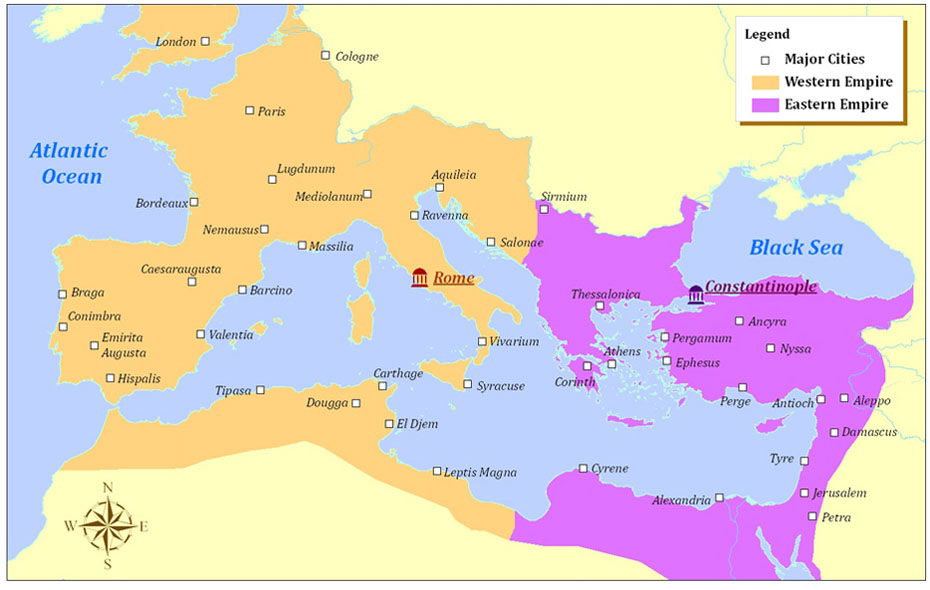
The Roman Empire was shaped like a donut around the Mediterranean and the western border was weaker than the others. To defend this border from any barbarian invasion, it took many soldiers and resources. 


2) Economic Decline: 
During the last century of the empire, the army and the government grew larger and the Romans continued to import luxury goods. The Roman economy was not strong enough to support these activities.


3) Growth of Government:
The government kept demanding more from the people and the government officials were often dishonest and used their power to get rich. When leaders fought over who would become the next emperor, Rome's valuable resources were wasted.


4) Decline in The Work Force:
As the Roman death rate increased and the number of slaves decreased, the empire had fewer soldiers and fewer workers.


5) Lack Of Technology:
There were less workers available to produce the demands of the empire and Rome had very little machinery that could make human labor more productive. 


6) Military Defeat:
The Roman army was no longer strong enough to defeat the barbarians. 


In my opinion, the fall of Rome was due mostly to the fact that there was a huge problem with the economy which meant that the people could no longer afford anything to eat and forced them to leave their farms or their jobs. Automatically, there was a higher death rate, there were fewer workers and there were fewer soldiers. With fewer soldiers, the Roman army was no longer strong enough to defeat the barbarians. 


Saturday, January 28, 2012

'Jesus Christ Superstar' Movie Review


Why bother watching ‘Jesus Christ Superstar’?

If you are the kind of person who likes to watch a movie with repetitivegl songs, eccentric main characters and no dialogue, then you are sure to enjoy this rock opera. When ‘Jesus Christ Superstar’ first came out, it received a nomination for the Academy Award of Merit and won the Best Cinematography Award. In 1974, only one year after it was released, this well anticipated movie was nominated for the Oscars, the BAFTA Film Award, the UN Award and the Golden Globe. It also won the David award and a BAFTA Film Award. Personally, I do not think it deserved as many nominations, especially not the Oscars.

Originally a musical by Andrew Lloyd Webber and Tim Rice, this new rock opera, released on the 7th of August 1973, is directed by Norman Jewison who is also the producer, along with Patrick Palmer and Robert Stigwood. ‘Jesus Christ Superstar’ has mostly three main characters. Playing the main role of Jesus is Ted Neeley, in the role of Judas is Carl Anderson and finally, Yvonne Elliman stars as Mary Magdalene. In other minor roles are Barry Dennen as Pontius Pilate and Josh Mostel as King Herod.

The movie ‘Jesus Christ Superstar’ tells the story of the last few weeks of Jesus’ life, from their arrival to Jerusalem to the well-known crucifixion. The rock opera is shown from Judas Iscariot’s point of view and shows us the struggles he has to go through, as well as the decisions he has to make. We realize that he is trapped, and cannot do anything without hurting the ones he loves. Therefore, he has no choice but to obey to the people in a position of power and betray his friends. 


In my opinion, the soundtrack of ‘Jesus Christ Superstar’ does not fit in the movie and the songs do not portray the feelings of the characters. With lyrics written by Tim Rice and music by Andrew Lloyd Webber, Andre Previn and Hubert W. Spencer, you would have expected an energetic and fun soundtrack but all it was, was catchy. When a song consists of repeating, ‘What’s the buzz? Tell me what’s happening’ over and over for more than 20 times, I do not consider it lyrics or speech anymore.

Unlike movies that become classics along the years, this one did not pass the test of time. It was a hit as soon as it came out and people loved the catchy songs and beautiful decor, thus all the nominations and awards. But with time, less people became interested into watching a rock opera performed by hippies with a soundtrack of songs that are unfamiliar to the new generation. This is why most people who are familiar with this type of music may find this rock opera interesting. For others, like me, who are unfamiliar with the music and who did not live during the time period when the movie was filmed, the complete 108 minutes may be boring and uninteresting. I would rate this movie 2 out of five stars. One star for the picturesque landscapes presented all along the movie and the other for… actually, I only rate this movie one star. I cannot think of any other things that I enjoyed. 

Sunday, November 27, 2011

I find that Augustus was a better Roman leader as he started an era of peace in Rome. The Pax Romana, or Roman Peace. He Built a permanent, professional army of 150,000 men and he founded a special unit called the Praetorian Guard. This consisted of 9,000 men who were in charge of guarding the emperor. Later, this became very important in politics. Augustus also conquered new territories, rebuilt Rome, he imported grain from Africa for the poor because he knew that they would cause less trouble if they were well-fed. He appointed a consul or governor to each of Rome's provinces, he reformed laws to make them easier to understand and apply and he reformed the Roman tax system.


Tuesday, November 22, 2011

Julius Caesar

From my point of view, Julius Caesar was a Reformer. Even though he was believed to be too ambitious and did things that may make him seem like a dictator, Caesar did many memorable things for many people. Caesar had a very good military strategy and won the support of his soldier. He strengthened and expanded Rome and started jobs so that the poor could become wealthier. Caesar also treated his defeated enemies fairly and generously. To some, he even gave government positions and to others that came from a foreign state, granted citizenship. By doing this, he ended the rule of corrupt Roman nobles.
In conclusion, he was admired greatly by the people and brought order and peace to Rome.